Introduction
The “personal information safety worksheet for children” stands as an essential educational resource, primarily tailored for elementary school students (grades 1-5) but readily adaptable for both younger and older learners. This printable tool plays a crucial role in reinforcing fundamental internet safety concepts through engaging, hands-on learning. Educators and parents consistently trust printable worksheets as effective pedagogical instruments for cultivating digital awareness and fostering responsible online behavior. These resources provide a tangible, focused approach to complex topics, allowing children to process information at their own pace and solidify understanding through active participation. A well-designed worksheet offers a structured framework for discussions about online privacy, helping to build a secure foundation for navigating the digital world safely and confidently. The tangible nature of a worksheet supports diverse learning styles, making abstract digital concepts more concrete and understandable for developing minds.
💡 Educational Key Takeaways:
- Core Skill: Structured Personal Information Safety Worksheet For Children focused on developing pencil grip, stroke control, and early literacy/math confidence.
- Target Scope: Suited for homeschoolers, preschool, kindergarten, and elementary learners.
- Best Recommendation: Practice 10–15 minutes daily with ergonomic writing tools to reinforce muscle memory without hand fatigue.
What This Worksheet Covers
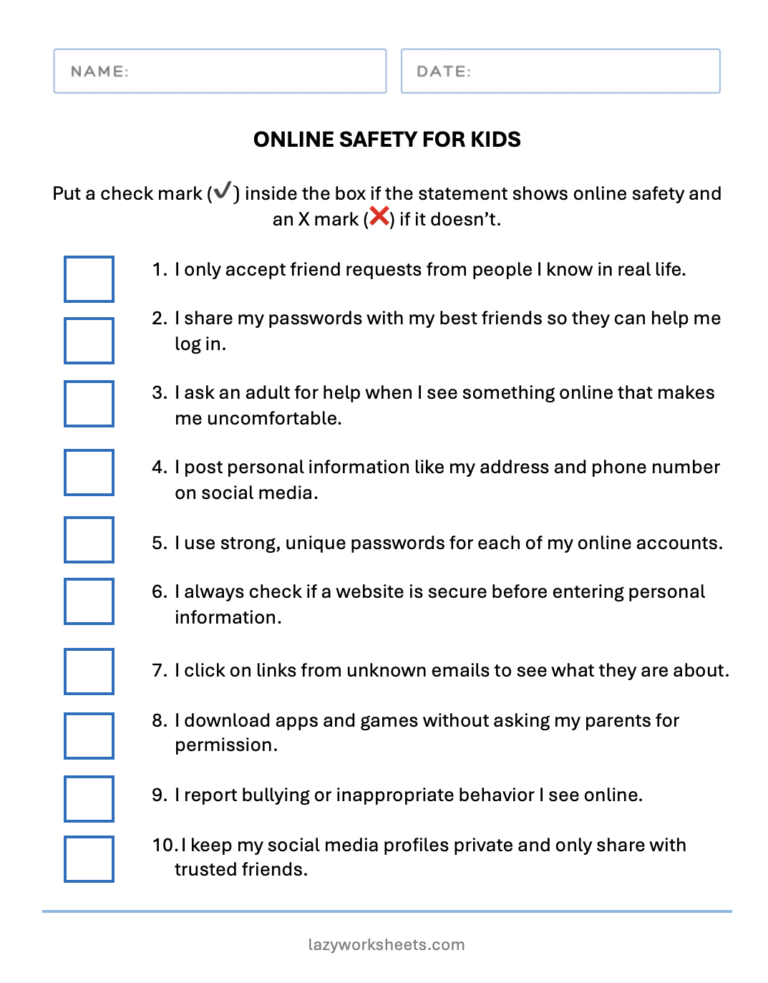
The “personal information safety worksheet for children” meticulously addresses the critical topic of identifying and protecting private information in online environments. It delves into distinguishing between information that is safe to share and information that must remain confidential. Concepts explored include personal identifiers such as full names, addresses, phone numbers, school names, and passwords. The worksheet introduces scenarios that illustrate potential risks associated with oversharing and emphasizes the importance of digital boundaries. Furthermore, it highlights the role of trusted adults in seeking help and guidance when encountering uncertain or uncomfortable online situations. The content directly aligns with recognized digital citizenship and child safety education standards, which advocate for early instruction on privacy, self-protection, and responsible online interactions. This foundational learning helps children develop an innate sense of caution and discretion regarding their digital footprint.
Key Learning Outcomes
By completing the “personal information safety worksheet for children,” students will develop several vital skills and knowledge areas:. Browse more guides on Safe Wired Schools.
- Students will accurately identify various types of personal information that should not be shared online.
- Children will articulate the potential dangers and consequences of sharing private details with strangers or in public online spaces.
- Learners will practice making safe online decisions, understanding when to keep information private and when it might be appropriate to share with trusted individuals.
- Participants will recognize and name trusted adults (parents, guardians, teachers) who can offer assistance and advice regarding online safety concerns.
How to Use This Worksheet
Educators can integrate the “personal information safety worksheet for children” into digital literacy lessons, while parents can utilize it as a valuable home learning activity. The worksheet typically features a variety of engaging activity types designed to scaffold learning progressively. These may include fill-in-the-blank questions to define personal information, matching exercises connecting types of information to sharing rules, true or false statements to test comprehension, and simple scenarios requiring children to identify safe or unsafe actions. Some sections might encourage drawing or reflection, allowing younger learners to express understanding visually. The difficulty level is carefully calibrated to be accessible to elementary students, with clear, concise instructions guiding each step. This resource functions effectively as a standalone activity, providing a focused review of personal information safety. It can also serve as a foundational component of a broader internet safety lesson plan or be assigned as homework to extend learning beyond the classroom or initial discussion.
Practical Tips for Parents and Teachers
Maximizing the educational impact of the “personal information safety worksheet for children” involves thoughtful preparation and facilitation.
- Before introducing the worksheet, engage children in a brief discussion about what “personal information” means and why privacy matters, using age-appropriate language and relatable examples.
- Encourage active participation by allowing children to read instructions aloud or discuss their answers with a partner or small group, fostering collaborative learning.
- After completion, review the worksheet together, using it as a springboard for deeper conversation. Ask “why” questions to prompt critical thinking about their choices and understanding.
- Connect the worksheet concepts to real-world online experiences, discussing how these rules apply to games, apps, or websites children might use, solidifying practical application.
- Consider creating a “family internet safety agreement” or “classroom online rules” based on the worksheet’s principles, turning abstract concepts into concrete guidelines.
Age-Appropriate Recommendations
Adapting the “personal information safety worksheet for children” ensures its effectiveness across the wide age spectrum of early learners. For Ages 58 (Early Elementary), direct guidance is paramount. Adults should read instructions aloud, provide vocabulary support for terms like “private” or “confidential,” and facilitate answers through discussion rather than expecting independent work. The focus here remains on simple identification of unsafe information and knowing to ask a trusted adult for help. Pacing should be slow, with breaks as needed, and artistic expression (drawing what “safe” looks like) can enhance engagement.
For Ages 912 (Late Elementary/Early Middle School), students can engage more independently. The worksheet serves as a tool for reinforcing concepts and prompting deeper thought. Discussion prompts can explore the reasons behind safety rules and introduce scenarios with more nuanced choices, such as identifying phishing attempts or understanding privacy settings. Encourage students to explain their reasoning for each answer, promoting critical thinking. The worksheet can initiate discussions about consequences of sharing and the importance of digital reputation.
For Ages 1318 (Middle/High School), while the core content remains relevant, the worksheet can act as a foundational review or a catalyst for advanced discussions. Older students can analyze the worksheet’s scenarios, propose alternative safe actions, and then extend the conversation to include topics like cyberbullying, digital footprints, and the implications of privacy on social media. The worksheet can be used as a pre-assessment to gauge existing knowledge or as a prompt for creating their own internet safety campaigns or presentations, fostering leadership in digital citizenship.
Frequently Asked Questions
Q: What age range is most suitable for this “personal information safety worksheet for children”? A: The worksheet is primarily designed for elementary school children (ages 6-10), offering foundational concepts. Its content is easily adaptable for younger learners with adult guidance or for older students as a review and springboard for more advanced discussions.
Q: How can one access and download this free printable worksheet? A: The “personal information safety worksheet for children” is available for free download directly from the SafeWiredSchools.org website. Navigate to the “Worksheets” section, locate the resource, and click the download button for instant access.
Q: Can this worksheet be used as part of a recurring internet safety curriculum? A: Absolutely. This worksheet serves as an excellent component within a comprehensive internet safety curriculum. It can be revisited periodically to reinforce key concepts, especially as children’s online interactions evolve, ensuring consistent understanding of personal information safety.
Explore More Free Printable Worksheets
A single educational resource, however valuable, achieves its greatest impact when integrated into a consistent learning routine. The “personal information safety worksheet for children” represents just one facet of a comprehensive approach to digital literacy. Educators and parents are encouraged to explore a full collection of free printable internet safety worksheets, activity sheets, checklists, quizzes, and more at SafeWiredSchools.org Worksheets. This extensive library covers every crucial internet safety topic, from cyberbullying prevention to screen time management, and is thoughtfully designed for every grade level and learning environment, ensuring continuous support for fostering responsible digital citizens.
Developmental Milestone & Activity Table
| Development Stage | Recommended Daily Duration | Primary Learning Objective |
|---|---|---|
| Preschool & Pre-K | 10 – 15 Minutes | Pencil grip development & basic pre-stroke lines |
| Kindergarten | 15 – 20 Minutes | Letter/number formation & spatial line awareness |
| Early Elementary (Grade 1–2) | 20 – 30 Minutes | Fluency, sentence construction & neatness |