Introduction
Educating young learners about navigating the digital world safely constitutes a fundamental responsibility for both families and schools. The “free digital citizenship worksheet for kids” offers a crucial resource for this endeavor, specifically tailored for Elementary grades 15. This printable learning tool reinforces essential internet safety concepts through engaging, hands-on activities. Educators and parents consistently rely on printable worksheets as trusted instruments for building digital awareness and fostering responsible online behavior. Such resources provide a tangible, focused approach to complex topics, allowing children to interact with information in a structured and memorable way. The tactile experience of writing and drawing complements digital learning, ensuring a comprehensive understanding of what it means to be a good digital citizen. Integrating these materials into daily routines helps establish foundational knowledge for a lifetime of safe online engagement.
💡 Educational Key Takeaways:
- Core Skill: Structured Free Digital Citizenship Worksheet For Kids focused on developing pencil grip, stroke control, and early literacy/math confidence.
- Target Scope: Suited for homeschoolers, preschool, kindergarten, and elementary learners.
- Best Recommendation: Practice 10–15 minutes daily with ergonomic writing tools to reinforce muscle memory without hand fatigue.
What This Worksheet Covers
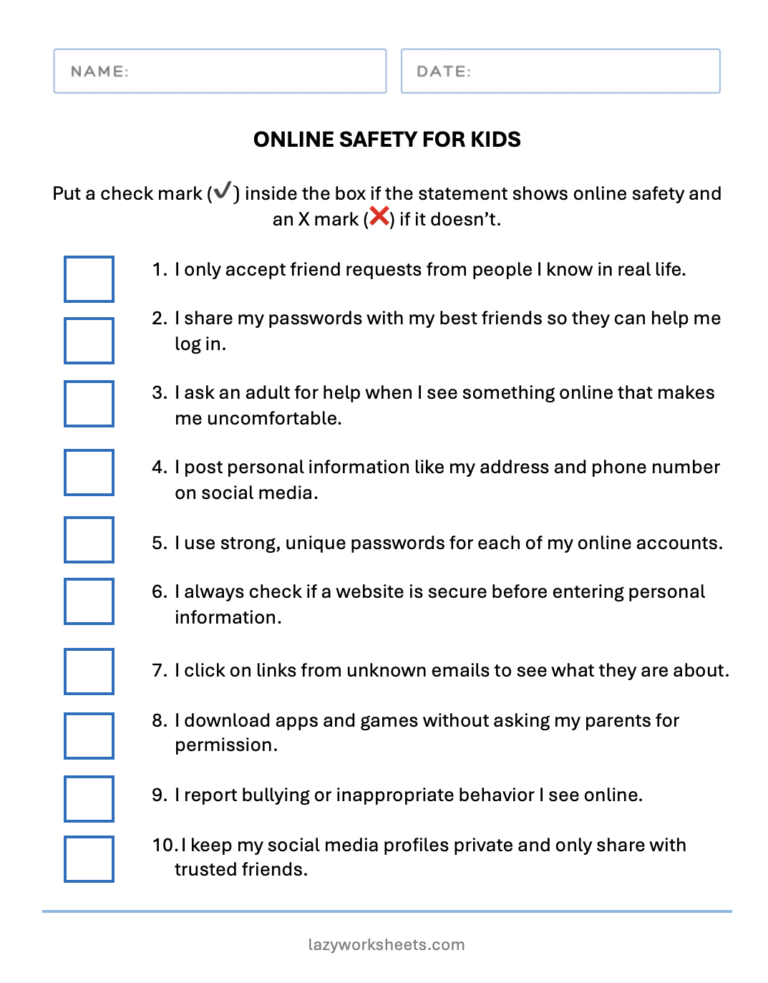
The “free digital citizenship worksheet for kids” addresses critical internet safety topics suitable for elementary-aged children, focusing on foundational principles of online responsibility and personal safety. This particular worksheet covers identifying trusted adults for help, understanding what constitutes private personal information, and recognizing the importance of asking for permission before sharing anything online. It also introduces basic concepts of respectful online communication and the idea of a “digital footprint.” The content directly aligns with recognized digital citizenship education standards, such as those emphasizing safety and security, privacy, and positive online interactions. Through relatable scenarios and clear instructions, children learn to make informed decisions about their online presence and interactions, building a proactive approach to internet safety from an early age.
Key Learning Outcomes
By completing the “free digital citizenship worksheet for kids,” learners will develop several essential skills and knowledge areas crucial for online safety:. Browse more guides on Safe Wired Schools.
- Children will identify and differentiate between appropriate and inappropriate personal information to share online, enhancing their understanding of privacy boundaries.
- Learners will recognize the importance of seeking permission from a trusted adult before engaging with new online content or sharing personal details, promoting responsible decision-making.
- Students will articulate at least two trusted adults they can approach with online safety concerns, establishing a vital support network.
- Participants will understand that actions online create a lasting digital footprint, encouraging mindful and considerate digital behavior.
How to Use This Worksheet
Educators and parents can effectively integrate the “free digital citizenship worksheet for kids” into various learning environments. The worksheet typically features a mix of engaging activity types, including fill-in-the-blank questions reinforcing key vocabulary, matching exercises connecting concepts with definitions, true or false statements to test comprehension, and simple drawing prompts encouraging creative expression of safe practices. Scenario-based questions prompt critical thinking about real-world online situations, fostering problem-solving skills. The difficulty level is carefully calibrated for elementary students, with instructions designed to scaffold learning progressively, ensuring accessibility for different learning styles. This resource functions excellently as a standalone activity for a quick safety review, as an integral part of a broader digital citizenship lesson plan, or as a thoughtful homework assignment to extend learning beyond the classroom or dedicated screen time. Its printable format facilitates focused individual work and serves as a tangible reference point for future discussions.
Practical Tips for Parents and Teachers
Maximizing the educational impact of the “free digital citizenship worksheet for kids” involves thoughtful preparation and engagement. First, review the worksheet beforehand to familiarize yourself with its content and identify any areas requiring additional explanation for specific learners. Second, encourage open discussion throughout the activity; ask children to elaborate on their answers, fostering deeper understanding rather than just seeking correct responses. Third, consider sharing personal, age-appropriate examples of online safety scenarios to make concepts more relatable and concrete for the child. Fourth, after completion, use the worksheet as a springboard for ongoing conversations about digital citizenship, perhaps by creating a family internet safety agreement or a classroom code of conduct. Finally, extend the learning by exploring related topics through interactive games or videos, reinforcing the lessons in varied formats.
Age-Appropriate Recommendations
Implementing the “free digital citizenship worksheet for kids” effectively requires tailoring the approach to different developmental stages within the elementary age range. For Ages 5-7 (Early Elementary), a highly supportive approach is most beneficial. Vocabulary support may be necessary for terms like “private information” or “digital footprint,” perhaps by replacing complex words with simpler synonyms or providing clear visual aids. Activities should be paced slowly, allowing ample time for comprehension and discussion. A high level of parental or teacher involvement is recommended, with adults reading instructions aloud and guiding children through each section step-by-step. For Ages 8-10 (Later Elementary), children possess a greater capacity for independent work and abstract thinking. The worksheet can be introduced with a brief overview, allowing learners to complete sections more autonomously. Facilitators should still be available for questions and to lead a comprehensive discussion upon completion, delving deeper into the “why” behind safety rules. Encouraging peer-to-peer discussion can also be valuable for this age group, fostering collaborative learning around digital ethics.
Frequently Asked Questions
Q: What specific age range is this worksheet designed for? A: The “free digital citizenship worksheet for kids” is primarily designed for elementary school children, specifically targeting grades 1-5 (ages 6-10). Its content and activities are tailored to their developmental stage.
Q: How can I access and download the free printable worksheet? A: Accessing the free printable is straightforward. The worksheet can be downloaded directly from the SafewiredSchools.org website by navigating to the “Worksheets” section and locating the specific title, then clicking the download button.
Q: Can this worksheet be used in a group setting, like a classroom? A: Absolutely. The worksheet is well-suited for group settings. It can facilitate classroom discussions, serve as an individual activity during a lesson, or be used as a collaborative exercise, promoting shared learning about digital safety.
Explore More Free Printable Worksheets
A single worksheet forms one component of a robust digital safety education program. Consistent learning routines yield the most significant results. Educators and parents are encouraged to explore a comprehensive collection of free printable internet safety worksheets, activity sheets, checklists, quizzes, and more. These resources, covering every internet safety topic and designed for every grade level and learning environment, are available at SafeWiredSchools.org Worksheets. Building a complete curriculum with these diverse materials ensures children receive ongoing, age-appropriate instruction vital for navigating the digital world securely and responsibly.
Developmental Milestone & Activity Table
| Development Stage | Recommended Daily Duration | Primary Learning Objective |
|---|---|---|
| Preschool & Pre-K | 10 – 15 Minutes | Pencil grip development & basic pre-stroke lines |
| Kindergarten | 15 – 20 Minutes | Letter/number formation & spatial line awareness |
| Early Elementary (Grade 1–2) | 20 – 30 Minutes | Fluency, sentence construction & neatness |