Introduction
The “internet safety activity sheet for grade 3” serves as an invaluable educational resource specifically designed for elementary learners. This printable worksheet targets children in the third grade, typically falling within the Ages 610 demographic. It provides a structured, hands-on approach to introducing and reinforcing fundamental internet safety concepts. Educators and parents consistently trust printable worksheets for their efficacy in building foundational digital awareness and promoting responsible online behaviors. Such resources offer a tangible, engaging method for children to interact with crucial information, moving beyond passive reception to active learning. The tactile nature of these activities supports diverse learning styles, ensuring key safety messages resonate deeply with young minds. Through focused tasks, children develop an early understanding of how to navigate the digital world securely, fostering habits that will serve them throughout their online lives.
💡 Educational Key Takeaways:
- Core Skill: Structured Internet Safety Activity Sheet For Grade 3 focused on developing pencil grip, stroke control, and early literacy/math confidence.
- Target Scope: Suited for homeschoolers, preschool, kindergarten, and elementary learners.
- Best Recommendation: Practice 10–15 minutes daily with ergonomic writing tools to reinforce muscle memory without hand fatigue.
What This Worksheet Covers
This “internet safety activity sheet for grade 3” addresses several core internet safety topics pertinent to young children. The content focuses on essential concepts such as identifying trusted adults, understanding the difference between private and public information, recognizing safe online interactions, and knowing when and how to report something concerning. Scenarios presented on the sheet guide children through common online situations, prompting critical thinking about appropriate responses. It clarifies simple rules for online conduct, emphasizing the importance of asking for permission before sharing information or downloading content. The worksheet‘s design aligns with established digital citizenship and child safety education standards, providing an accessible entry point into complex topics. It prepares learners for increasingly sophisticated digital environments by establishing a strong groundwork in personal safety and responsible online engagement.
Key Learning Outcomes
Completing this activity sheet will enable children to develop several important skills and knowledge areas:
- Identification of Trusted Adults: Children will learn to recognize and name trusted adults they can approach with online concerns.
- Understanding Private Information: Learners will distinguish between information safe to share and personal details that must remain private.
- Safe Online Practices: Students will identify and apply basic rules for safe internet use, such as asking permission.
- Critical Thinking for Online Scenarios: Children will practice evaluating simple online situations and determining appropriate actions.
- Empowerment to Report: The activity sheet encourages children to understand the importance of telling a trusted adult about anything that makes them feel uncomfortable online.
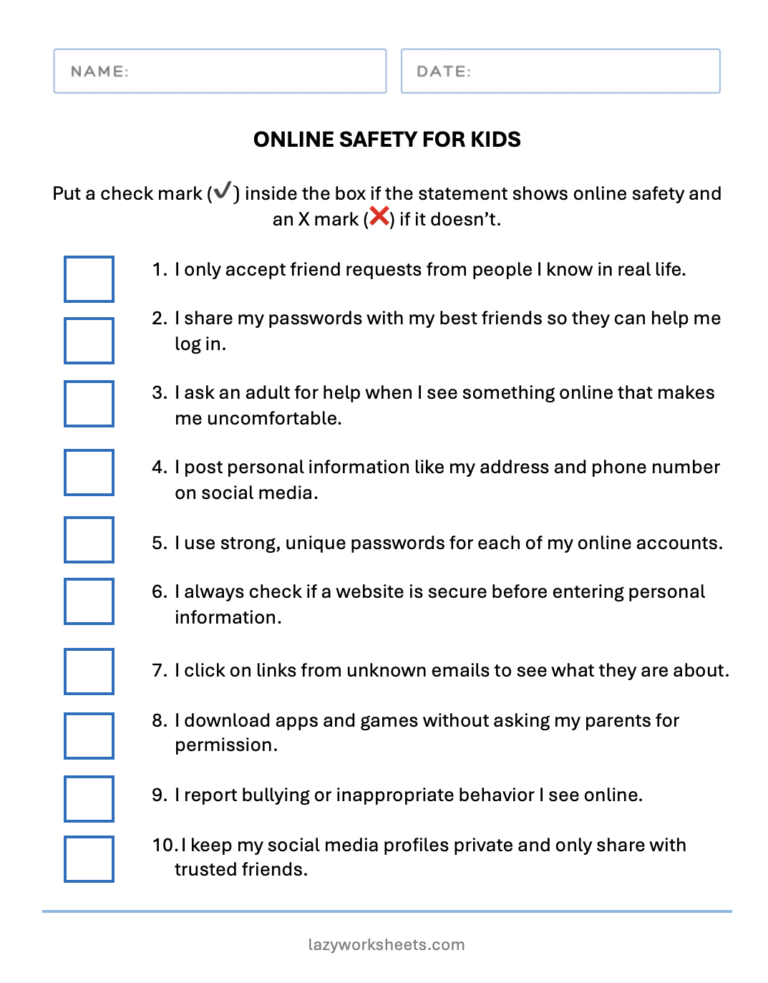
How to Use This Worksheet
The “internet safety activity sheet for grade 3” offers versatile application for both classroom instruction and home learning environments. This worksheet typically features a blend of activity types designed to maintain engagement, including fill-in-the-blank questions, matching exercises, true or false statements, simple drawing prompts, and short scenario-based responses. The difficulty level is carefully calibrated for third-grade comprehension, ensuring accessibility without oversimplification. Instructions are presented clearly and progressively, scaffolding learning from basic recall to simple application. This resource functions effectively as a standalone activity for a focused lesson on a specific safety topic. It can also integrate seamlessly into a broader digital citizenship curriculum, serving as a review tool or an introduction to new concepts. Furthermore, the worksheet provides a structured homework assignment, allowing children to reinforce learning outside the immediate instructional setting with parental guidance. Browse more guides on Safe Wired Schools.
Practical Tips for Parents and Teachers
- Preparation is Key: Before starting, briefly review the worksheet content to anticipate any questions children might have and gather necessary materials like crayons or pencils.
- Facilitate Discussion: Encourage open dialogue during and after completion. Ask open-ended questions related to the scenarios to prompt deeper thinking about choices and consequences.
- Connect to Real Life: Relate worksheet concepts to children’s actual online experiences or hypothetical situations they might encounter, making the learning more tangible and relevant.
- Role-Playing Scenarios: Extend the learning by role-playing some of the situations from the worksheet. This helps children practice appropriate responses in a safe environment.
- Positive Reinforcement: Acknowledge effort and correct answers with praise, focusing on the development of critical safety skills rather than just getting answers right.
Age-Appropriate Recommendations
While the “internet safety activity sheet for grade 3” is primarily tailored for Ages 8-9 (Grade 3), its foundational concepts are adaptable across a broader age range with appropriate adjustments. For children in the Ages 610 (Elementary Grades 1-5) band, this worksheet is most suitable. Direct supervision and clear explanations of vocabulary are beneficial. Activity pacing should allow for thoughtful consideration of each question, perhaps completing one section at a time. Parental or teacher involvement involves reading instructions aloud, clarifying terms, and guiding discussions. Younger children within this band (Grades 1-2) might require more direct assistance with reading and writing, focusing on the visual and discussion-based aspects. For Ages 35 (Preschool/Kindergarten), the worksheet’s content might be too advanced for independent completion. However, elements like identifying trusted adults or basic private information can be introduced verbally using the worksheet as a visual aid, focusing on simple concepts and large-group discussion rather than individual writing. For Ages 1118 (Middle/High School Grades 6-12), this particular worksheet serves best as a foundational review or a resource for peer-to-peer teaching. Older students could analyze the scenarios from a more mature perspective, discussing why these rules are important for younger children or even adapting the scenarios for more complex situations they might face. The vocabulary is simple, so focus shifts to reinforcing core principles and understanding the evolution of online safety.
Frequently Asked Questions
Q: What specific internet safety topics are covered in this worksheet? A: The worksheet covers identifying trusted adults, understanding private information, recognizing safe online interactions, and knowing when to report concerns. It also introduces basic rules for responsible online conduct.
Q: Is this activity sheet suitable for both home and classroom use? A: Yes, the “internet safety activity sheet for grade 3” is designed for flexible use in both educational and home settings. Its clear instructions and engaging activities make it effective for individual learning or group instruction.
Q: How can educators and parents access this free printable resource? A: This valuable resource is available for free download directly from the SafeWiredSchools.org website. Simply navigate to the worksheets section to locate and print the activity sheet for immediate use.
Explore More Free Printable Worksheets
Effective digital safety education thrives on consistency and a diverse range of learning opportunities. While the “internet safety activity sheet for grade 3” provides an excellent starting point, a single resource works best when integrated into a broader, ongoing learning routine. SafeWiredSchools.org offers an extensive collection of free printable internet safety worksheets, activity sheets, checklists, quizzes, and more. These resources cover a comprehensive array of internet safety topics, meticulously designed for every grade level and adaptable to various learning environments. Educators and parents are encouraged to explore the full collection at SafeWiredSchools.org Worksheets to build a robust and engaging digital safety curriculum.
Developmental Milestone & Activity Table
| Development Stage | Recommended Daily Duration | Primary Learning Objective |
|---|---|---|
| Preschool & Pre-K | 10 – 15 Minutes | Pencil grip development & basic pre-stroke lines |
| Kindergarten | 15 – 20 Minutes | Letter/number formation & spatial line awareness |
| Early Elementary (Grade 1–2) | 20 – 30 Minutes | Fluency, sentence construction & neatness |
Images References