Introduction
The digital landscape offers immense opportunities for learning and connection, yet it also presents unique challenges for young minds. Equipping children with essential internet safety knowledge is no longer optional; it is a fundamental aspect of modern education. For elementary students, particularly those in Grade 3, foundational digital literacy skills are crucial for navigating the online world safely and confidently. The “online safety worksheet for grade 3″ serves as a vital, free printable resource designed to reinforce these critical concepts through interactive, hands-on learning. Printable worksheets remain trusted tools for educators and parents alike, offering a tangible and focused method for building digital awareness, fostering responsible online behavior, and initiating important conversations about internet safety. These resources provide a structured approach to complex topics, making them accessible and engaging for young learners and ensuring that foundational safety principles are understood and internalized.
💡 Educational Key Takeaways:
- Core Skill: Structured Online Safety Worksheet For Grade 3 focused on developing pencil grip, stroke control, and early literacy/math confidence.
- Target Scope: Suited for homeschoolers, preschool, kindergarten, and elementary learners.
- Best Recommendation: Practice 10–15 minutes daily with ergonomic writing tools to reinforce muscle memory without hand fatigue.
What This Worksheet Covers
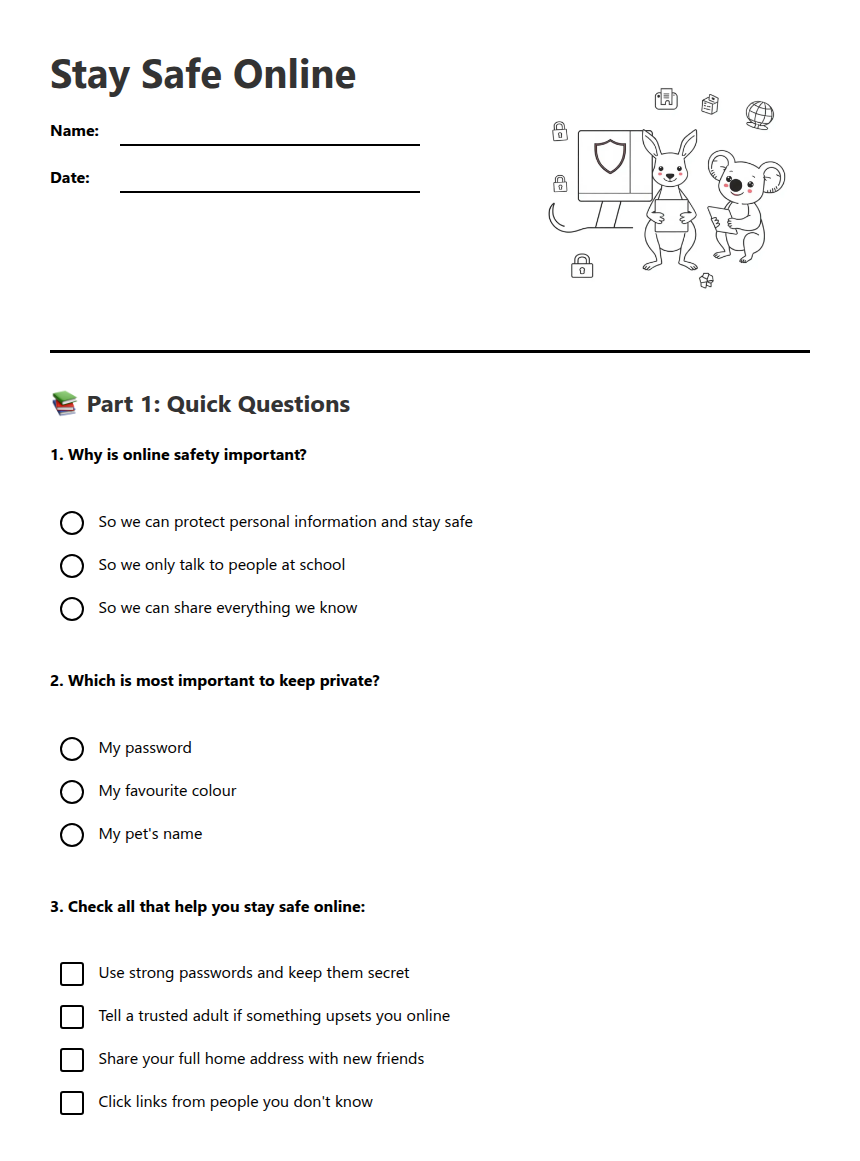
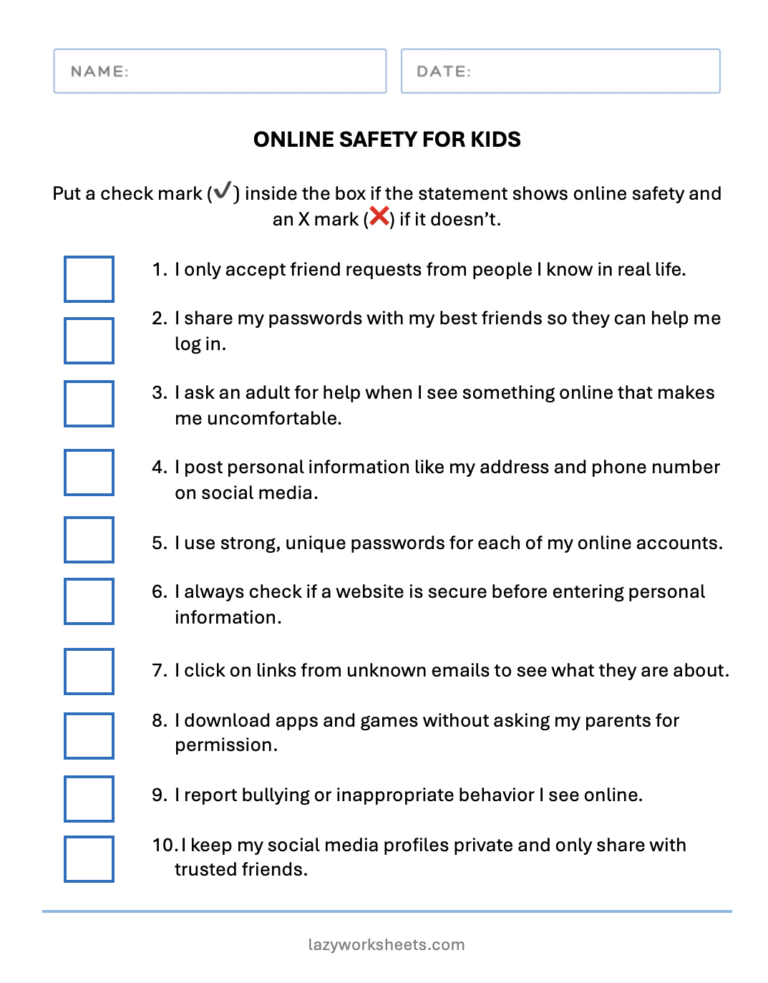
The “online safety worksheet for grade 3″ addresses several core internet safety topics tailored specifically for the developmental stage of 8- and 9-year-olds. The content focuses on practical, actionable advice that children can immediately apply. Key areas covered include identifying personal information that should never be shared online, understanding the concept of private versus public information, recognizing the importance of asking for adult permission before visiting new websites or downloading applications, and learning to identify trusted adults who can assist with online concerns. The worksheet also introduces basic concepts of online etiquette and the idea that what is posted online can be seen by many and can last forever. These topics align directly with recognized digital citizenship and child safety education standards, which emphasize responsible use, privacy protection, and the ability to seek help when needed. The activities are designed to build a proactive mindset towards online safety, empowering children to make informed decisions.
Key Learning Outcomes
Upon completing the “online safety worksheet for grade 3,” students will develop several crucial skills and knowledge areas:. Browse more guides on Safe Wired Schools.
- Ability to identify and protect personal information, such as full name, address, phone number, and school.
- Understanding the importance of seeking permission from a trusted adult before engaging with new online content or communicating with strangers.
- Skill in recognizing potential online risks, such as suspicious links or requests for personal details from unknown sources.
- Awareness that actions and words shared online have lasting consequences and can impact others.
- Confidence in knowing when and how to report an uncomfortable or unsafe online experience to a trusted adult.
How to Use This Worksheet
The “online safety worksheet for grade 3” is structured to facilitate engaging and effective learning, whether utilized in a classroom setting or within the home environment. The worksheet typically incorporates a variety of activity types suitable for this age group, including fill-in-the-blank questions to reinforce vocabulary, matching exercises to connect concepts with examples, true or false statements to test comprehension, and simple scenario-based questions that encourage critical thinking about real-world situations. Some sections may include drawing prompts, allowing children to visually represent their understanding of safe online practices. Instructions are presented clearly and progressively, scaffolding learning from simpler recall tasks to more complex application of knowledge. This resource can function as a standalone activity to introduce or review specific safety rules, as an integral part of a broader lesson plan on digital citizenship, or as a valuable homework assignment to encourage family discussions about online safety. Its printable nature allows for repeated use and easy integration into existing curricula.
Practical Tips for Parents and Teachers
- Preparation and Setup: Print the worksheet in advance and ensure writing tools are readily available. Consider printing extra copies for practice or review.
- Facilitate Discussion: Do not simply provide answers. Encourage children to explain their reasoning for each response, fostering deeper understanding rather than rote memorization.
- Personalize Scenarios: Discuss how the worksheet’s scenarios relate to the childs own online experiences, making the learning more relevant and impactful.
- Create a Safe Space: Emphasize that questions or concerns about online activities are always welcome, ensuring children feel comfortable approaching adults without fear of judgment.
- Extend the Learning: Follow up the worksheet activity by collaboratively creating a family online safety agreement or reviewing the school’s digital citizenship policies, reinforcing the concepts in a practical context.
Age-Appropriate Recommendations
The “online safety worksheet for grade 3” is specifically designed for children typically aged 8-9 years old. For this age band, the content directly addresses their burgeoning independence online while still requiring significant adult guidance. When using the worksheet with a Grade 3 student, a direct and interactive approach is most effective. Vocabulary should be clearly explained, and concepts such as “personal information” or “trusted adult” should be discussed with concrete examples relevant to their daily lives. Activity pacing should allow for thoughtful consideration and discussion, rather than rushing through answers. Adult involvement remains crucial, serving as a facilitator, question-answerer, and guide through the worksheet’s exercises. For children slightly younger (e.g., Grade 2), some concepts might require more simplification and one-on-one attention, focusing primarily on the most basic rules like asking permission. For children slightly older (e.g., Grade 4), the worksheet can serve as a valuable review, with discussions extending into more nuanced situations and potential consequences of online actions, allowing for independent thought and problem-solving while still offering adult support as needed.
Frequently Asked Questions
Q: What specific internet safety topics are covered in the “online safety worksheet for grade 3”?
A: The worksheet covers essential topics such as identifying personal information, understanding permission for online activities, recognizing trusted adults, and differentiating between safe and unsafe online interactions. It focuses on practical, actionable steps for young learners.
Q: How can parents and teachers access the free printable “online safety worksheet for grade 3”?
A: The worksheet is available for free download directly from the SafeWiredSchools.org website. Simply navigate to the worksheets section, locate the “online safety worksheet for grade 3,” and click the download button for a printable PDF file.
Q: Is this worksheet suitable for children slightly younger or older than Grade 3?
A: While optimized for Grade 3, the worksheet can be adapted. Younger children (Grade 2) may require more adult support and simplification, focusing on core concepts. Older children (Grade 4) can use it for review, with discussions extending to more complex scenarios and critical thinking.
Explore More Free Printable Worksheets
A single resource, however valuable, functions best when integrated into a comprehensive and consistent digital safety learning routine. The “online safety worksheet for grade 3” is an excellent starting point, but continuous reinforcement is key to developing robust digital citizenship skills. Educators and parents are encouraged to explore the extensive collection of free printable internet safety worksheets, activity sheets, checklists, quizzes, and more available at SafeWiredSchools.org Worksheets. These resources cover a wide spectrum of internet safety topics, catering to every grade level and learning environment, ensuring that children receive ongoing, age-appropriate guidance as they grow in their online journeys.
Developmental Milestone & Activity Table
| Development Stage | Recommended Daily Duration | Primary Learning Objective |
|---|---|---|
| Preschool & Pre-K | 10 – 15 Minutes | Pencil grip development & basic pre-stroke lines |
| Kindergarten | 15 – 20 Minutes | Letter/number formation & spatial line awareness |
| Early Elementary (Grade 1–2) | 20 – 30 Minutes | Fluency, sentence construction & neatness |
Images References