Introduction
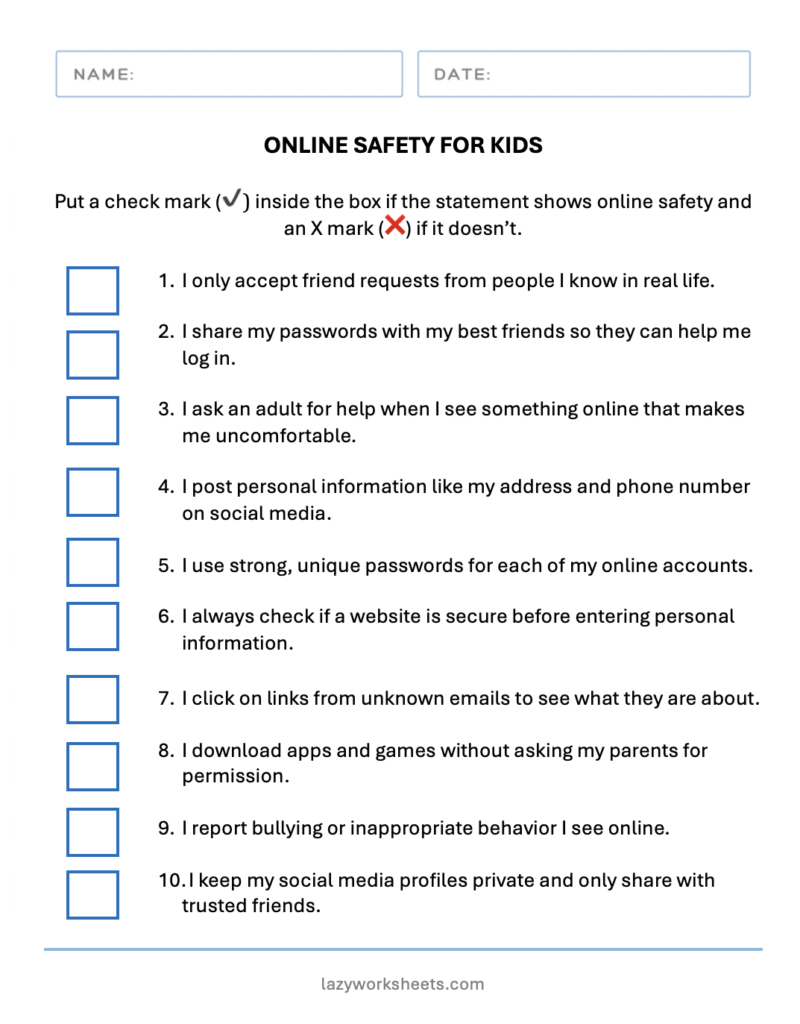
Reinforcing vital internet safety concepts for young people is paramount in today’s digital landscape. The “online safety quiz for students” is a valuable, free printable resource designed primarily for Elementary (grades 1-5) and Middle School (grades 6-8) learners, though adaptable for a wider age range. This hands-on worksheet serves as an effective tool for educators and parents to solidify understanding of responsible online behavior. Printable worksheets remain trusted pedagogical instruments, offering a tangible, screen-free method for building digital awareness and fostering critical thinking skills necessary for navigating the internet safely. Their tactile nature allows for focused engagement, promoting deeper retention of crucial safety principles through active participation. This resource provides a foundational approach to understanding digital citizenship, ensuring children develop secure habits from an early age, equipping them for a lifetime of safe online interaction.
💡 Educational Key Takeaways:
- Core Skill: Structured Online Safety Quiz For Students focused on developing pencil grip, stroke control, and early literacy/math confidence.
- Target Scope: Suited for homeschoolers, preschool, kindergarten, and elementary learners.
- Best Recommendation: Practice 10–15 minutes daily with ergonomic writing tools to reinforce muscle memory without hand fatigue.
What This Worksheet Covers
The “online safety quiz for students” addresses fundamental internet safety topics, presenting scenarios and questions pertinent to common online interactions. Concepts covered typically include identifying personal information that should never be shared online, recognizing suspicious links or messages, understanding the importance of strong and private passwords, and basic awareness of cyberbullying. The worksheet also touches upon the concept of online strangers and the need for parental permission before downloading apps or visiting new websites. The content directly aligns with recognized digital citizenship frameworks and child safety education standards, focusing on empowering students to make informed decisions and fostering a proactive approach to their digital well-being. It translates complex safety rules into accessible, actionable knowledge suitable for young learners.
Key Learning Outcomes
By completing the “online safety quiz for students,” learners will achieve several crucial developmental and educational milestones related to digital safety. Browse more guides on Safe Wired Schools.
- Students will be able to identify personal information that should never be disclosed to unknown individuals or websites.
- Learners will recognize common online risks, such as phishing attempts, unsafe downloads, and interactions with strangers.
- Children will understand the importance of creating strong, unique passwords and keeping them confidential.
- Participants will develop critical thinking skills to evaluate online content and interactions for safety and appropriateness.
- Students will be able to articulate responsible online communication practices, including kindness and respect in digital spaces.
How to Use This Worksheet
The “online safety quiz for students” is structured to facilitate engaging and effective learning, employing a mix of activity types such as multiple-choice questions, true or false statements, and scenario-based prompts. Instructions are clear and scaffold learning progressively, ensuring students can follow along independently or with minimal guidance. The difficulty level is appropriate for elementary and middle school students, allowing for both comprehension and challenge. This worksheet can be seamlessly integrated into various educational settings: it functions exceptionally well as a standalone activity to introduce or review safety topics, as an integral component of a broader digital citizenship lesson plan, or as a focused homework assignment designed to reinforce classroom discussions. Its adaptable format ensures utility across different teaching and learning environments, providing a flexible resource for busy educators and parents.
Practical Tips for Parents and Teachers
Maximizing the educational impact of the “online safety quiz for students” involves thoughtful preparation and facilitation.
- Review content beforehand: Familiarization with the quiz questions and answers allows for proactive support and deeper discussion during the activity.
- Encourage open discussion: After completion, facilitate a group or one-on-one conversation about the answers, exploring the “why” behind each correct response.
- Connect to real-life scenarios: Discuss how the principles learned in the quiz apply to the student’s own online activities and experiences.
- Extend the learning: Consider role-playing different online situations or creating a family internet safety agreement based on the quiz topics.
- Celebrate participation: Acknowledge effort and correct answers, fostering a positive attitude towards learning about online safety.
Age-Appropriate Recommendations
Adapting the “online safety quiz for students” for various age groups ensures its maximum effectiveness and relevance. For Ages 5-8 (Early Elementary), the worksheet requires significant adult involvement; reading questions aloud, explaining vocabulary, and guiding children through answers will be beneficial. Focus should be on very basic concepts like not talking to strangers online or asking an adult before clicking links. For Ages 9-12 (Upper Elementary/Early Middle School), students can often complete the quiz more independently, but a follow-up discussion is crucial for consolidating understanding. This age group benefits from exploring the “why” behind safety rules and discussing hypothetical scenarios. For Ages 13-18 (Middle/High School), the quiz can serve as a refresher or a starting point for more complex discussions about digital footprint, privacy settings, cyber ethics, and critical evaluation of online sources. While independent completion is expected, the insights gained can prompt deeper, nuanced conversations about personal responsibility and long-term consequences in the digital realm. The core concepts remain relevant across these age bands, but the depth of discussion and level of scaffolding will vary significantly.
Frequently Asked Questions
Q: What age group is the “online safety quiz for students” primarily designed for? A: The quiz is primarily designed for Elementary (grades 1-5) and Middle School (grades 6-8) students, but its foundational concepts can be adapted for younger learners with adult guidance or used as a refresher for older students. It covers essential internet safety principles relevant to a broad range of ages.
Q: How can this quiz be integrated into existing lesson plans or home routines? A: The quiz works effectively as a pre-assessment to gauge existing knowledge, a review activity after teaching a digital safety unit, or a discussion starter for family conversations about online rules. It can also serve as a homework assignment to reinforce classroom learning.
Q: Where can the “online safety quiz for students” be downloaded for free? A: This free printable resource, along with many other valuable internet safety materials, is available for download on the SafeWiredSchools.org website. Navigate to the “Worksheets” section to access and print the quiz for immediate use.
Explore More Free Printable Worksheets
A single worksheet forms a vital part of a comprehensive digital safety learning routine. Effective internet safety education thrives on consistent reinforcement and varied learning experiences. Educators and parents are encouraged to explore the extensive collection of free printable internet safety worksheets, activity sheets, checklists, quizzes, and more at SafeWiredSchools.org Worksheets. This diverse range of resources covers every essential internet safety topic, meticulously designed for every grade level and learning environment, ensuring continuous and engaging educational support for all young digital citizens.
Developmental Milestone & Activity Table
| Development Stage | Recommended Daily Duration | Primary Learning Objective |
|---|---|---|
| Preschool & Pre-K | 10 – 15 Minutes | Pencil grip development & basic pre-stroke lines |
| Kindergarten | 15 – 20 Minutes | Letter/number formation & spatial line awareness |
| Early Elementary (Grade 1–2) | 20 – 30 Minutes | Fluency, sentence construction & neatness |