Introduction
The digital landscape evolves constantly, presenting both vast opportunities and complex challenges for young people. Equipping early learners, from elementary through middle school ages, with essential digital literacy skills is paramount for their safety and well-being. A foundational resource designed to reinforce these critical concepts is the internet safety multiple choice worksheet. This printable tool serves as an accessible, engaging method for students to test their understanding of online risks and responsible digital citizenship. Educators and parents consistently trust printable worksheets for their tangible nature, providing a hands-on approach to learning that complements digital instruction. They offer a concrete way to build digital awareness and foster responsible online behavior in a structured, review-based format. Such resources solidify knowledge through direct engagement, bridging the gap between abstract concepts and practical application.
💡 Educational Key Takeaways:
- Core Skill: Structured Internet Safety Multiple Choice Worksheet focused on developing pencil grip, stroke control, and early literacy/math confidence.
- Target Scope: Suited for homeschoolers, preschool, kindergarten, and elementary learners.
- Best Recommendation: Practice 10–15 minutes daily with ergonomic writing tools to reinforce muscle memory without hand fatigue.
What This Worksheet Covers
The internet safety multiple choice worksheet addresses several core internet safety topics crucial for navigating the online world securely. It covers essential areas such as distinguishing between safe and unsafe personal information sharing, recognizing common online scams like phishing, understanding the importance of strong passwords, and identifying appropriate responses to cyberbullying. Concepts related to privacy settings, responsible online communication etiquette, and the necessity of reporting inappropriate content are also explored. The worksheet content directly aligns with established digital citizenship frameworks and child online safety education standards, ensuring that learners develop a comprehensive understanding of protective online practices. Each question is crafted to stimulate critical thinking about real-world online scenarios, preparing young users for actual digital interactions.
Key Learning Outcomes
By completing the internet safety multiple choice worksheet, learners will achieve several vital educational milestones:
- Distinguishing safe online practices from risky behaviors, enhancing personal digital security.
- Identifying potential online threats, such as phishing attempts and misinformation, improving vigilance.
- Understanding the critical importance of privacy settings and protecting personal information across platforms.
- Developing critical thinking skills necessary for making informed and responsible decisions in various online situations.
- Recognizing appropriate actions and reporting mechanisms when encountering cyberbullying or uncomfortable online content.
How to Use This Worksheet
The internet safety multiple choice worksheet offers a flexible and effective tool for both classroom instruction and home-based learning. This resource primarily features multiple-choice questions, often presented within short scenarios that require learners to select the safest or most responsible course of action. The difficulty level is carefully calibrated to be accessible for elementary and middle school students, with instructions designed to scaffold learning progressively. It can function as a valuable standalone activity, providing a quick check of understanding after a lesson on digital safety. Alternatively, it integrates seamlessly into a broader lesson plan as a review exercise, a formative assessment tool, or a discussion starter. For homework assignments, the worksheet encourages independent reinforcement of key safety principles, allowing students to consolidate their knowledge at their own pace. Browse more guides on Safe Wired Schools.
Practical Tips for Parents and Teachers
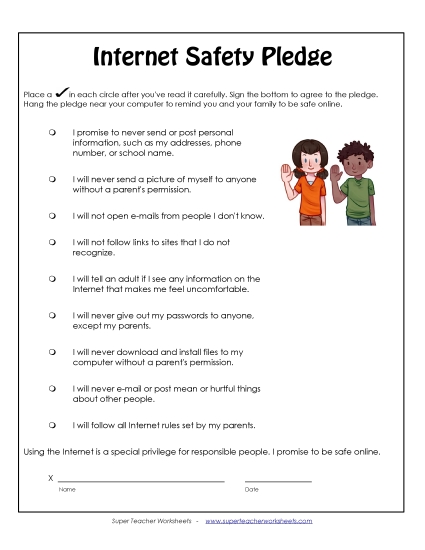
Maximizing the educational impact of the internet safety multiple choice worksheet involves thoughtful preparation and facilitation. First, review the worksheet beforehand to familiarize oneself with the questions and potential discussion points, ensuring a clear understanding of the material. During the activity, encourage students to think critically about each option, rather than simply guessing, prompting them to explain their reasoning for selected answers. After completion, facilitate an open discussion about the questions, exploring why certain answers are correct and others are not, which deepens comprehension. Consider pairing the worksheet with a related activity, such as creating a personal internet safety pledge or role-playing different online scenarios, to extend learning beyond the printed page. Regularly revisit these safety topics, using the worksheet as a benchmark for ongoing understanding and skill development.
Age-Appropriate Recommendations
Tailoring the use of the internet safety multiple choice worksheet to specific age groups ensures optimal engagement and learning outcomes. For Ages 610 (Elementary School), an adult’s direct involvement is highly recommended. Reading each question aloud and explaining unfamiliar vocabulary can support comprehension, and discussions should focus on concrete examples and simple rules, like “don’t share your address.” Pacing should be slower, allowing ample time for thought and clarification. For Ages 1114 (Middle School), students can often complete the worksheet independently or in small groups. Discussions can delve into more nuanced scenarios, exploring the “why” behind safety rules and the potential consequences of risky online actions. The worksheet can serve as a springboard for debates on digital ethics and personal responsibility. For Ages 1518 (High School), the worksheet can function as a quick refresher or a starting point for advanced discussions on topics like digital footprint management, online reputation, and the complexities of online privacy laws, requiring minimal direct supervision but encouraging critical self-reflection.
Frequently Asked Questions
Q: What specific age range is the internet safety multiple choice worksheet best suited for? A: This worksheet is primarily designed for elementary and middle school students, roughly ages 8-14. Its content and format are adaptable for both younger learners with adult guidance and older students for quick review.
Q: How can educators or parents access this free printable internet safety resource? A: The internet safety multiple choice worksheet is available for free download directly from the SafeWiredSchools.org website. Simply navigate to the ‘Worksheets’ section and locate the title to access the printable PDF file.
Q: Can this worksheet be used as an assessment tool? A: Yes, this multiple-choice worksheet can effectively serve as a formative assessment tool. It helps gauge students’ current understanding of key internet safety concepts and identifies areas where further instruction or discussion may be needed.
Explore More Free Printable Worksheets
A single resource, while valuable, works best as part of a comprehensive and consistent digital safety learning routine. The internet safety multiple choice worksheet is one of many valuable tools available for fostering secure online habits. Educators and parents are invited to explore a full collection of free printable internet safety worksheets, activity sheets, checklists, quizzes, and more at SafeWiredSchools.org Worksheets. This extensive collection covers every internet safety topic imaginable, meticulously designed for every grade level and diverse learning environment, ensuring continuous reinforcement of crucial digital literacy skills.
Developmental Milestone & Activity Table
| Development Stage | Recommended Daily Duration | Primary Learning Objective |
|---|---|---|
| Preschool & Pre-K | 10 – 15 Minutes | Pencil grip development & basic pre-stroke lines |
| Kindergarten | 15 – 20 Minutes | Letter/number formation & spatial line awareness |
| Early Elementary (Grade 1–2) | 20 – 30 Minutes | Fluency, sentence construction & neatness |