Introduction
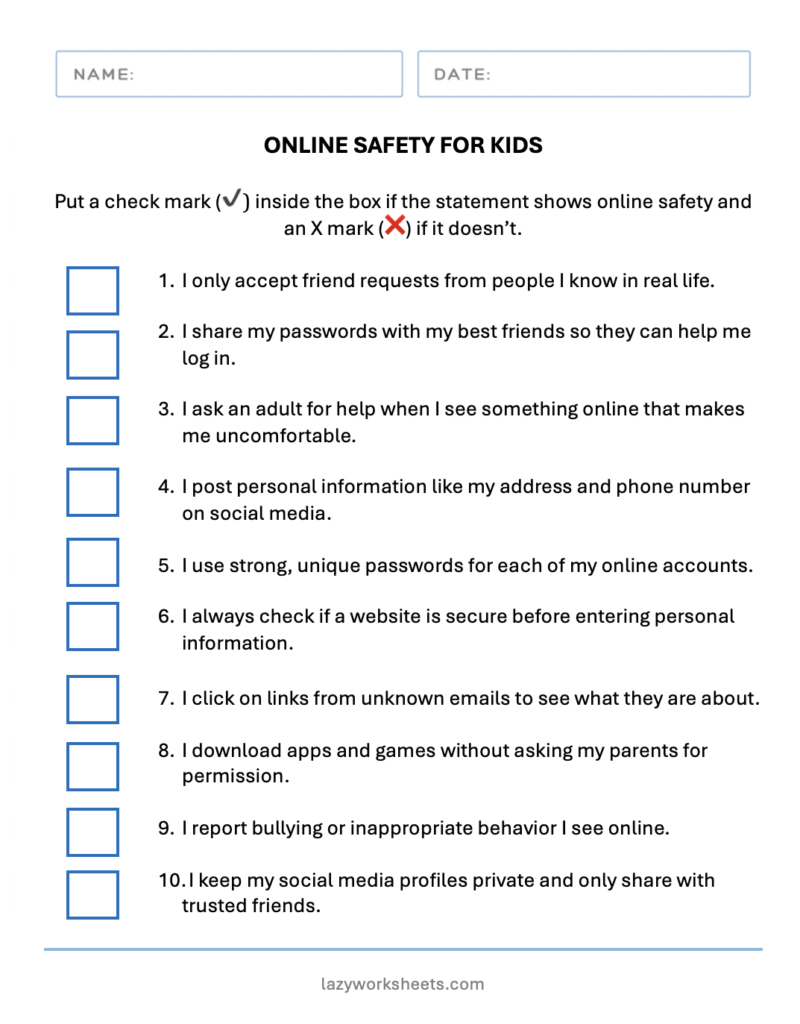
The digital landscape evolves constantly, necessitating adaptable educational resources for fostering responsible online behavior. A pivotal tool in this endeavor is the “social media safety worksheet for kids,” a free, printable resource designed to reinforce critical internet safety concepts. This worksheet primarily targets Middle and High School students (grades 6-12), addressing the complexities of social media use during these formative years. Its content is thoughtfully crafted to be accessible and engaging, making it a valuable asset for both educators in classroom settings and parents guiding children at home. Printable worksheets remain trusted pedagogical instruments, offering a tangible, hands-on approach to learning. They facilitate active engagement, encourage critical thinking, and provide a structured framework for discussing sensitive topics. By offering a physical medium for interaction, these resources help solidify understanding and promote the development of essential digital awareness, laying a strong foundation for responsible online citizenship. The worksheet’s design reflects an understanding of developmental stages, ensuring that the material presented is both relevant and impactful for young learners navigating social platforms.
💡 Educational Key Takeaways:
- Core Skill: Structured Social Media Safety Worksheet For Kids focused on developing pencil grip, stroke control, and early literacy/math confidence.
- Target Scope: Suited for homeschoolers, preschool, kindergarten, and elementary learners.
- Best Recommendation: Practice 10–15 minutes daily with ergonomic writing tools to reinforce muscle memory without hand fatigue.
What This Worksheet Covers
The “social media safety worksheet for kids” addresses several crucial internet safety topics pertinent to young people’s online interactions. Specific concepts explored include understanding and managing privacy settings, the implications of responsible sharing of personal information and content, and strategies for identifying misinformation and fake news. It also delves into the prevention and reporting of cyberbullying, emphasizing empathetic online communication. The worksheet highlights the lasting impact of a digital footprint and introduces methods for its responsible cultivation. Furthermore, it covers the importance of reporting mechanisms for inappropriate content or contact and encourages a healthy balance between online and offline activities. The content aligns with recognized digital citizenship and child safety education standards, promoting the development of critical thinking, media literacy, and ethical decision-making skills in the online environment. Each section is presented with clarity, aiming to empower young users with the knowledge required to navigate social media platforms safely and confidently.
Key Learning Outcomes
Completing the “social media safety worksheet for kids” contributes to several significant educational milestones for young learners.
- A comprehensive understanding of privacy settings and the implications of sharing personal data online is developed.
- Students gain the ability to critically evaluate online content, enhancing their capacity to identify misinformation and assess source credibility.
- Effective strategies for fostering positive online interactions and preventing cyberbullying are acquired.
- An awareness of the lasting nature of a digital footprint and its impact on future opportunities is cultivated.
- Knowledge of appropriate reporting mechanisms for encountering harmful content or suspicious interactions is established.
How to Use This Worksheet
The “social media safety worksheet for kids” offers versatile application in both educational and home environments. The worksheet incorporates a variety of activity types designed to engage learners progressively. These include fill-in-the-blank questions to test vocabulary, matching exercises for concept association, true or false statements to challenge assumptions, scenario-based questions to encourage problem-solving, and reflective prompts for personal application. The difficulty level is appropriate for middle and high school students, with instructions clearly scaffolding learning. It can function effectively as a standalone activity, providing a focused exploration of social media safety principles. Alternatively, the worksheet integrates seamlessly into broader lesson plans on digital citizenship, serving as a reinforcement tool or an introductory exercise. For homework assignments, it encourages independent thought and allows for deeper reflection outside structured class time. Its adaptable format ensures that educators and parents can tailor its use to specific learning objectives and individual student needs, maximizing its educational impact. Browse more guides on Safe Wired Schools.
Practical Tips for Parents and Teachers
- Review and Prepare: Before presenting the worksheet, thoroughly review its content and questions. Identify any areas that might require additional explanation or discussion, and consider gathering supplementary resources like relevant news articles or examples of privacy settings.
- Foster Open Dialogue: Create a safe and non-judgmental environment for discussion. Encourage students or children to share their experiences and ask questions, facilitating an honest exchange about online challenges and solutions.
- Utilize Discussion Prompts: After completion, use targeted discussion prompts to deepen understanding. Ask questions such as, “What surprised you most about social media safety?” or “How will you apply what you learned to your own online behavior?”
- Connect to Real-World Scenarios: Relate the worksheet’s concepts to current events, common online situations, or hypothetical scenarios relevant to the learners’ experiences. This helps bridge the gap between abstract rules and practical application.
- Extend Learning Beyond the Worksheet: Encourage further engagement by suggesting related activities, such as creating a family social media use agreement, researching privacy policies of popular apps, or designing a digital safety public service announcement.
Age-Appropriate Recommendations
Implementing the “social media safety worksheet for kids” effectively requires consideration of the learners’ developmental stages and existing digital literacy levels. The content is primarily designed for Middle School (Ages 11-14) and High School (Ages 15-18), with adaptability for younger learners.
For Upper Elementary (Ages 8-10), the worksheet can be introduced with significant adult involvement. Focus should remain on fundamental concepts like “thinking before posting,” understanding basic personal information, and recognizing trusted adults to report concerns. Vocabulary support is crucial, with activities paced slowly and emphasizing direct, clear examples. Discussion should be highly guided, reinforcing simple, actionable safety rules.
When used with Middle School (Ages 11-14) students, the worksheet serves as an excellent foundation for exploring more nuanced topics. Concepts like digital footprint, cyberbullying prevention, and the importance of privacy settings can be discussed in greater depth. Encourage independent completion followed by group discussions, allowing for peer learning and sharing of perspectives. Facilitator guidance should focus on encouraging critical thinking and ethical considerations.
For High School (Ages 15-18) learners, the worksheet can initiate advanced discussions on online reputation management, identifying sophisticated online scams, the legal implications of online actions, and the responsible use of social media for activism or personal branding. This age group benefits from case studies, independent research prompts, and opportunities to lead peer discussions, fostering a comprehensive understanding of their digital responsibilities and opportunities. The worksheet acts as a springboard for deeper exploration of complex digital citizenship themes.
Frequently Asked Questions
Q: What age range is “social media safety worksheet for kids” most suitable for? A: The worksheet is primarily designed for middle and high school students (ages 11-18) but can be adapted for upper elementary learners (ages 8-10) with adult guidance and simplified discussion.
Q: How can “social media safety worksheet for kids” be accessed? A: This free printable resource is available for download directly from the SafeWiredSchools.org website. A clear link or button will guide users to the printable PDF.
Q: Can this worksheet be used in a group setting? A: Absolutely. The “social media safety worksheet for kids” is ideal for classroom discussions, small group activities, or family conversations, fostering collaborative learning and peer-to-peer insights.
Explore More Free Printable Worksheets
Integrating the “social media safety worksheet for kids” into a consistent digital safety learning routine maximizes its effectiveness. A single worksheet provides valuable insights, but its impact is amplified when part of a broader collection of educational resources. Educators and parents are invited to explore a full collection of free printable internet safety worksheets, activity sheets, checklists, quizzes, and more at SafeWiredSchools.org Worksheets. This extensive library covers every internet safety topic, meticulously designed for every grade level and learning environment, ensuring comprehensive and continuous digital safety education for all young learners.
Developmental Milestone & Activity Table
| Development Stage | Recommended Daily Duration | Primary Learning Objective |
|---|---|---|
| Preschool & Pre-K | 10 – 15 Minutes | Pencil grip development & basic pre-stroke lines |
| Kindergarten | 15 – 20 Minutes | Letter/number formation & spatial line awareness |
| Early Elementary (Grade 1–2) | 20 – 30 Minutes | Fluency, sentence construction & neatness |